How Cells Communicate: From Molecular Signals to Biological Responses
Explore how cells receive molecular signals, transmit information and produce biological responses, with examples and methods for studying cell communication.
Cell biology / Signals, mechanisms & experimental evidence
How Cells Communicate: From Molecular Signals to Biological Responses
Cells continually interpret their surroundings. A molecule released by one cell can influence the activity of another, connecting molecular interactions with changes in growth, movement or gene expression. Following that connection reveals both the organisation of living systems and the experiments needed to understand them.
01 𖡼 A shared biological language connects cells
A living tissue contains cells with different roles, yet their activities must remain coordinated. Communication allows individual cells to respond to changing conditions while participating in a larger biological system. Signals influence processes such as secretion, metabolism and movement; they also help organise interactions between neighbouring cells.
In molecular terms, a message is not a written instruction. It is an interaction that changes the probability or rate of a biological event. A signalling molecule can bind a receptor, alter its activity and initiate further molecular changes. The receiving cell supplies the machinery that gives the interaction meaning. [1]
This distinction guides the rest of the story. Understanding communication requires more than identifying a molecule: we must follow where it travels, how it is recognised and what happens after recognition.
02 𖡼 Signals travel through different communication routes
The distance between communicating cells helps define the route. Paracrine signals act locally, whereas endocrine signals travel through the circulation. Autocrine signalling involves a cell responding to a signal it releases. Contact-dependent communication requires neighbouring surfaces to meet. [1]
| Route | Defining feature | Example |
|---|---|---|
| Paracrine | Local action on nearby cells | Local growth-factor signalling |
| Endocrine | Transport through the circulation | Hormonal communication |
| Autocrine | Response to a self-released signal | Self-reinforcing signalling loops |
| Contact-dependent | Direct interaction between cell surfaces | Membrane-bound ligand–receptor interaction |
Experimentally, these routes suggest different comparisons. A study of secreted signals might compare cells grown separately with cells exposed to conditioned medium. A contact-dependent hypothesis instead requires a design that distinguishes physical contact from the exchange of soluble material. The experimental arrangement should reflect the proposed route rather than assume it.
03 𖡼 Receptors turn molecular recognition into activation
Receptors provide a connection between an arriving signal and the receiving cell. Binding and activation are related but distinct events: a ligand can associate with a receptor, while signalling depends on the molecular changes that follow. Detecting receptor expression therefore does not establish that a pathway is active.
Pang and Zhou discuss a model in which ligands can bind receptor monomers or pre-existing dimers. Their commentary highlights that receptor activation cannot always be reduced to the simple assembly of two previously separate proteins. Receptor arrangement and structural changes also matter. [2]
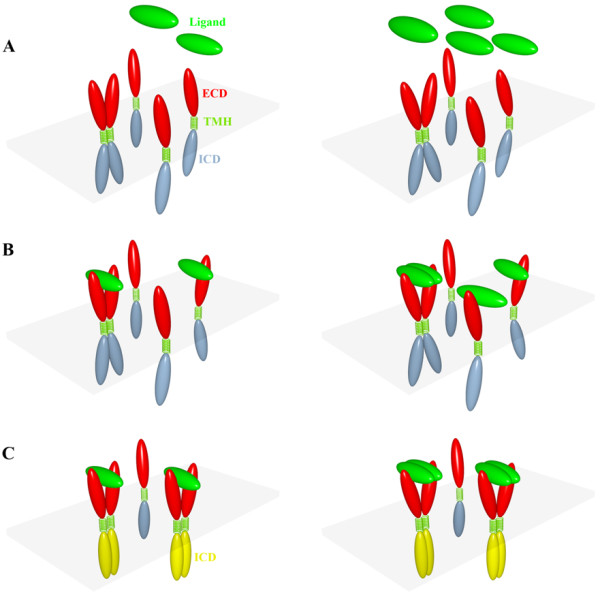
For a laboratory study, this encourages precise language. Measuring receptor abundance, ligand binding and downstream signalling answers three different questions. A convincing explanation connects those observations rather than treating them as equivalents.
04 𖡼 Intracellular pathways distribute the information
After reception, information is relayed through interacting molecular components. Chemokine receptors provide one example: these G-protein-coupled receptors connect extracellular recognition with intracellular G proteins and downstream effectors. [3]
The useful lesson is the branching architecture. A single receptor can influence multiple molecular events, so a pathway diagram should be read as a map of possible interactions rather than proof that every branch operates equally in every experiment.
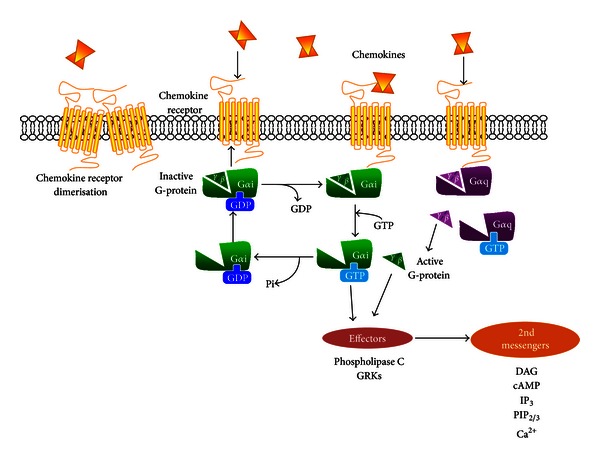
When reporting an experiment, identify the branch and event actually measured. An increase in one phosphoprotein signal should not automatically become a claim that an entire signalling network has been activated. Our protein phosphorylation guide develops this distinction further.
05 𖡼 Regulation makes signalling reversible and adaptable
Communication requires mechanisms that limit or redirect a response. In chemokine receptor systems, receptor phosphorylation, arrestin recruitment and internalisation contribute to regulation. Internalisation can also support further signalling, so it is not simply an off switch. [3]
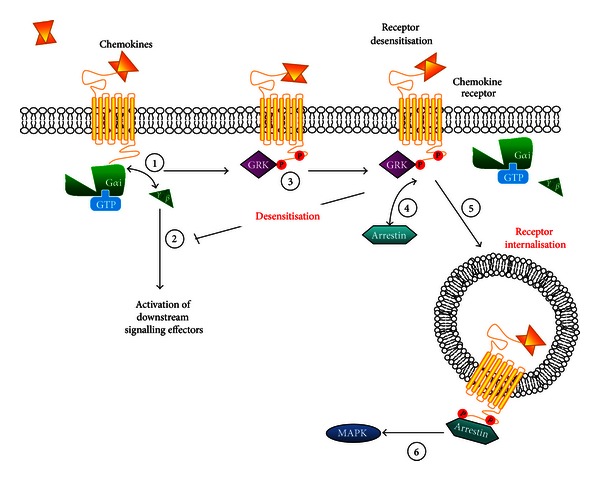
This creates an interpretation challenge. A weaker readout after prolonged treatment may reflect an earlier response followed by adaptation, rather than complete failure to respond. Comparing appropriately chosen time points can distinguish those possibilities. Experimental history therefore belongs in the explanation, alongside the treatment concentration and final measurement.
06 𖡼 Timing carries information that an endpoint can miss
Signalling has a temporal structure. Responses can be brief, sustained or pulsatile, and changes in duration or frequency can matter alongside changes in intensity. Purvis and Lahav review how cells encode and interpret information through these dynamic patterns. [4]
A primary research example comes from Albeck and colleagues. In the EGF-stimulated systems they studied, ERK activity occurred in discrete pulses whose characteristics varied with stimulation. Single-cell measurements connected differences in those patterns with cell-cycle entry. [5]
Imagine two experimental groups with a similar average signal at one endpoint. One could contain cells with sustained intermediate activity; another could contain cells alternating between high and low activity. An endpoint average alone cannot distinguish those hypothetical situations. A time course or live-cell measurement may therefore be essential when the question concerns signalling dynamics.
The ERK example does not establish a universal pattern for every pathway. It shows why the sampling strategy should be treated as part of the biological question.
07 𖡼 Communication can coordinate whole populations
Individual cells can participate in a collective relay: a signal activates neighbouring cells, which then contribute to further signal release. This differs from a single source supplying all responding cells directly.
Dieterle and colleagues analysed diffusive signalling relays and showed how the geometry of the cellular and extracellular environment can shape wave propagation. Their study also compared relay behaviour with observations from neutrophil swarming experiments. [6]
The conceptual importance is that cells can change the signal environment as they respond to it. A culture is therefore more than a passive collection of independent receivers. For experimental planning, cell density, spatial arrangement and medium conditions are variables worth considering when the hypothesis involves communication between cells.
Mathematical models help make these relationships explicit, but their assumptions must remain visible. A model can test whether a proposed mechanism explains a pattern; agreement does not establish that no alternative mechanism is possible.
08 𖡼 Different methods reveal different layers of the response
Once a biological mechanism has been proposed, the next task is to choose an observation that meaningfully tests it. A transcript measurement concerns RNA abundance. An antibody-based assay concerns the molecular target recognised by that reagent. Imaging adds spatial information, while live-cell reporters can reveal changes over time.
| Approach | Useful observation | Interpretation boundary |
|---|---|---|
| RT-qPCR | Abundance of selected RNA targets | Does not directly measure protein activity |
| Phospho-specific antibody assay | A selected phosphorylation-associated signal | Depends on specificity and sample handling |
| ELISA | Assay-defined analyte concentration | Concentration alone does not establish activity |
| Immunofluorescence | Spatial distribution of labelled targets | Overlapping signals do not prove direct interaction |
| Live-cell reporter | Changes in a reporter-defined process over time | Requires validation of what the reporter senses |
These approaches become more informative when their results are connected without collapsing their differences. A change in RNA does not need to match a protein readout immediately to be biologically meaningful. The two measurements may reflect different regulatory stages or timescales.
Continue with mRNA and protein expression differences and immunofluorescence and protein localisation for more detailed discussions of these readouts.
09 𖡼 A mechanism needs evidence beyond association
A treatment followed by a change establishes an observation, but it does not fully identify the molecular route responsible. A mechanistic study asks whether the timing, specificity and consequences of the proposed pathway fit the evidence. The controls should address the alternatives that could otherwise explain the result.
For example, a study of a signalling inhibitor might compare treated cells with a matched vehicle control while examining cell viability. A second perturbation acting through a different approach can help assess whether the interpretation depends on one reagent. Genetic and pharmacological approaches each have limitations; agreement between them is useful only when those limitations are considered.
Reagent selection is part of this reasoning. Antibody application evidence, recombinant protein activity and assay compatibility should be examined before a product is assigned a role in a workflow. Relevant background is available in our pages on antibodies and immunodetection, protein expression and function and biological assays and measurement.
Ultimately, reproducibility requires recording enough detail for another researcher to understand what was compared, how the signal was measured and how the conclusion followed from the data.
10 𖡼 Cell communication provides a foundation for biotechnology
The journey from an extracellular signal to a cellular response connects molecular biology with the organisation of living systems. Receptor recognition, intracellular networks, timing and collective behaviour are complementary parts of that connection.
For biotechnology, this perspective helps frame experiments around function. A reporter assay can be designed to investigate a defined signalling event. A cellular model can be evaluated for whether it reproduces the response relevant to the study. A screening experiment can distinguish a desired change in pathway behaviour from a general effect on cell health.
The central principle remains the same: select a meaningful biological question, choose measurements that can address it and interpret the outcome within the model’s limits. Scientific progress comes from making those connections testable.
From understanding to investigation: explore our scientific subjects, browse research products or contact KomaGene Biotech for product information and documentation.